


What is art? Hmm... That's an interesting idea, right? Art. What makes a human activity art?
As a writer, of course, writing should be included. But then, think about hair stylists. Isn't what they do for our hair an art? Or what about a cat? Living art?
In my mind, anything we think of as art is probably art. At least to our subjective analysis.
But let's look at this from a traditional point of view. Fine art is created with one or more of these 7 elements involved in its creation:
- line
- color
- shape
- value
- space
- texture
Is it like a culinary composition? No doubt. The recipe is the chefs' exhibition of the art they have created. They select an object to be cooked as their canvas to which they add spices and cooking styles to present the dish. Color and texture are quite important as is the line and space of their presentation on the plate. Every new value that is employed represents the chefs' work of art.
Fine artists' create their own recipes. Line may represent the idea, though not all artists are bound by line. Think of Jackson Pollock. As an abstract expressionist, his line is everywhere and anywhere. Though we may not see it without a lot of study, Pollock no doubt had line in his mind in creation, as line is merely a mark on a surface. But line did not define his work.
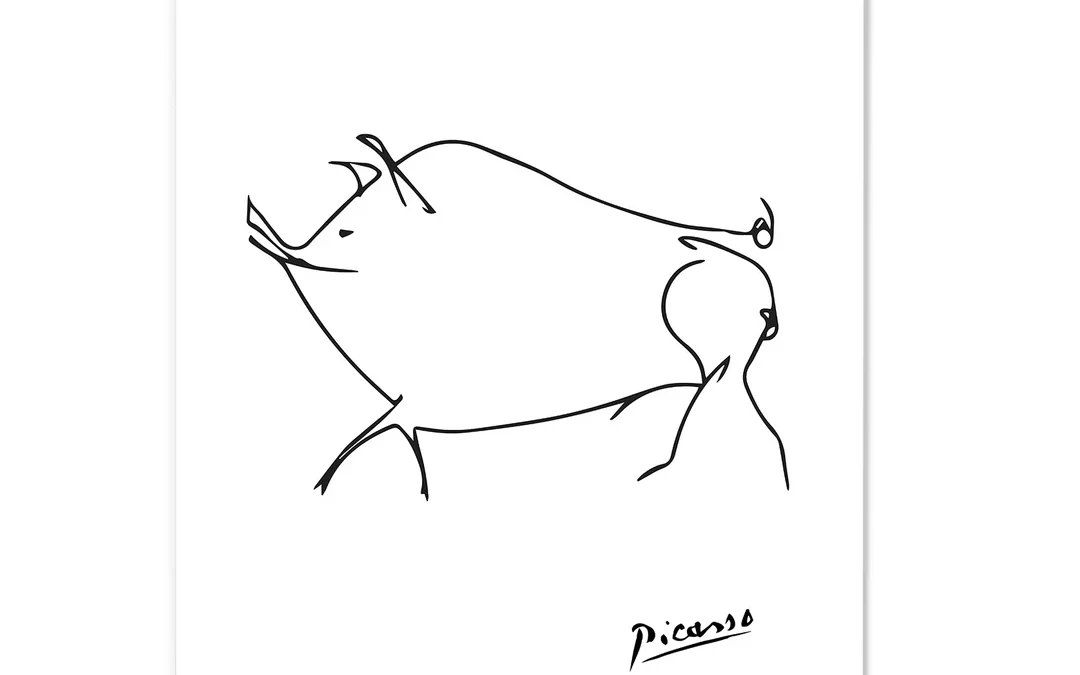
On the other hand, think Matisse. Many of his works began with line. Or Picasso, sometimes only the line mattered. Color and texture weren't part of the work. Line obviously mattered in some of this works.
Color isn't necessarily important in all fine art. Line drawings are a testament to this, unless you consider the colors to be black and white.
The line may become shape. Picasso's Pig Serigraph became the rustic shape of a pig. Andy Warhol's line became a soup can in one famous work.
Shape is a very important element of fine art, unless you're a minimalist like Agnes Martin, perhaps, whose Untitled No. 5 is white and off-white on white, you may not see where line comes in, but it does. Those colors are laid down in rows, one color and then, the next. These are values of white.
Space means the area around, within, and between objects and elements in a composition. Back to Pollock. His space was completely filled. Space just happened.
But texture? No, it's not adding a bit of burlap to a composition. Texture refers to the visual and tactile surface quality of a work of art. Though it can be the actual feel of a surface, it can also be the visual impression of how something would feel if touched. The artist can convey that feeling.
One of the most famous works to convey texture is Van Gogh's Starry Night. Or think Monet. In Water Lilies, he employed used thick strokes of paint giving his work an almost 3-dimensional quality.
The 7 elements of fine art can all be used in a work, or the artist is only the maker of one or three or four elements. Not all are required, but all can be important. It just depends on the artists' inspiration. See how many of these elements you can define in a work of your choice. Let us know in the comments below what your favorite painting is, and the elements used to create it.